
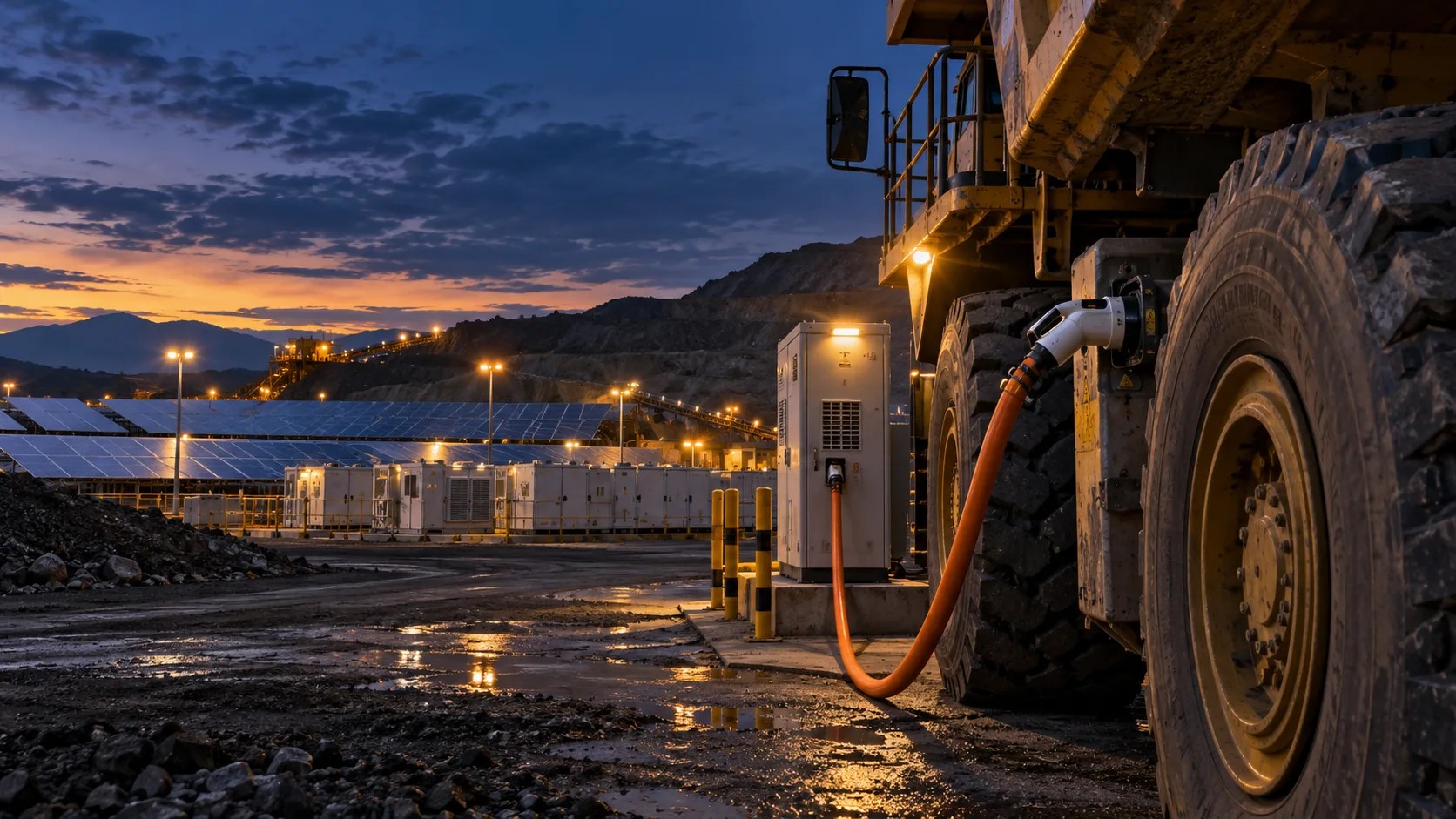
Electric fleets.
Prove the route.
Then scale.
From a small pilot to a large programme, the fleet and its power system must be designed together.
A 2,000-truck concept is a planning case.
This article develops the earlier large-fleet concept as an illustrative scale scenario. It is not an announcement of 2,000 trucks ordered, financed or deployed by TIN.
Start with the duty cycle.
Record loaded and empty kilometres, gradients, payload, average speed, stops, queue time and shift patterns. Compare battery-electric, hybrid and existing diesel options on the same productive-work basis. Run a route trial before specifying a fleet-wide replacement.
Size the power system around operations.
Account for usable battery capacity, charging windows, charger availability, conversion losses and simultaneous demand. Assess solar, battery storage and grid or other firm supply together; solar generation alone does not establish continuous charging capacity.
Model the whole cost.
- Truck and battery acquisition or lease payments.
- Charging infrastructure, connection costs and electricity tariffs.
- Maintenance, tyres, payload effects and downtime.
- Battery warranty, degradation, replacement and residual value.
- Measured cost per delivered tonne and emissions using actual energy sources.
IEA Global EV Outlook 2026 reports electric-truck sales more than doubling in 2025. Road-truck market progress supports investigation, but does not establish the economics of a particular mining route. [8]
How TIN can support the programme.
We coordinate suitability studies, OEM and equipment comparisons, lease options, charging and energy design, mobilisation plans and performance reporting. Each phase has agreed acceptance criteria before the next commitment.

